The Clear Lake Cores Story, Part 3: Preserving the Collection for Future Research
In the first two parts of the Clear Lake Cores Story, we explored the history of the cores and their potential to reveal thousands of years of environmental change around Clear Lake. Now, CLERC has taken on the next challenge: protecting, organizing, and documenting the cores and the decades of research materials connected to them.
Part 2: Unearthing 130,000 Years Beneath Clear Lake
It is a project we did not necessarily plan to undertake, but one we believe is too important to ignore.
How the Collection Came to CLERC
The story of these cores begins with the U.S. Geological Survey (USGS), which drilled sediment cores in and around Clear Lake during the 1970s as part of its scientific investigations of the lake.
Dr. David Adam, now a CLERC board member, was working for USGS during the 1970s and 1980s. His research focused in part on fossil pollen preserved in lake sediments and what it could reveal about past vegetation, climate, and environmental conditions. His research using the Clear Lake cores resulted in a pollen study published in 1988.
In 1995, when USGS was preparing to dispose of the cores, David obtained them so that this valuable scientific material would not be lost. Many of the cores, along with decades of research records and related materials, were stored in a storage unit in Lower Lake. Some of the cores were also moved to the barn of Ray Mostin, who helped preserve them for many years.
Following Ray’s death, our current CLERC organization obtained the cores that had been stored at his property in the fall of 2024.
Today, our challenge is bringing the pieces of this much longer scientific history back together.
Bringing the Collection Together
Over the course of his career, David accumulated not only the sediment cores but also geological and biological samples, field notes, publications, correspondence, maps, research records, specimens, and scientific equipment.
CLERC has now completed the initial sorting of more than 180 boxes of research materials, a variety of specimens and equipment from the storage unit David has been using for decades. We sorted and moved the collection into a new CLERC storage unit.
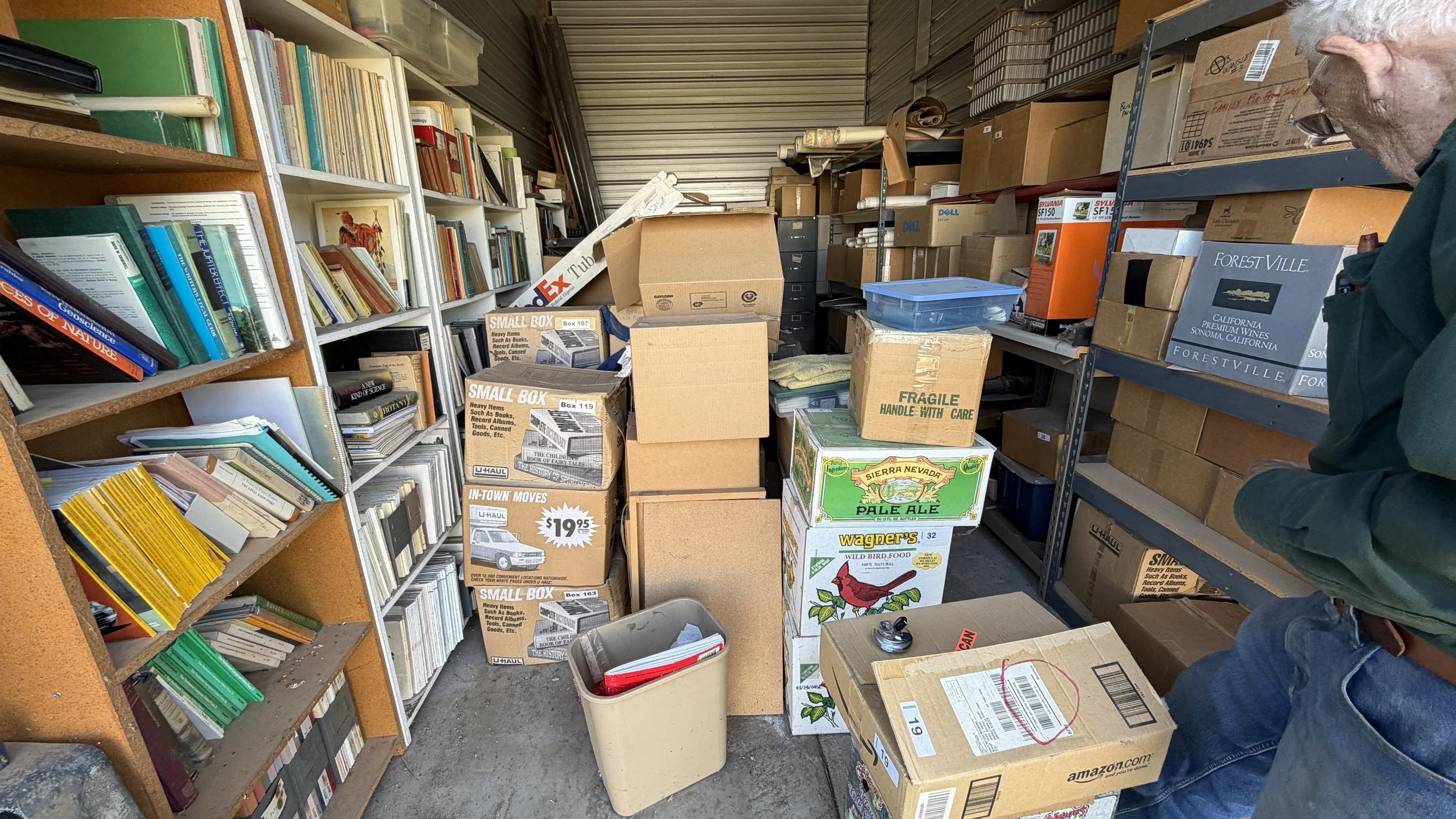
Decades of research collected by David Adam
The cores are also being cleaned, sorted, documented, and prepared for relocation to the same storage unit. Once that work is complete, the cores and their associated research materials will be stored together in one location.
That may sound like a simple logistical step, but it is an important one. A core becomes much more useful when researchers can connect it with the maps, notes, labels, publications, and other records that explain where it was collected, its depth, how it was sampled, and what previous researchers learned from it.
A handwritten note or old map may turn out to provide the missing context for a section of core collected decades ago. Our goal is to preserve those connections before they are lost.
Research Assistant Cole Hayes
To get this project started, CLERC gathered together a chunk of its operating budget to temporarily hire Research Assistant Cole Hayes, who, luckily for us, grew up in Lake County.
Cole is completing a Bachelor of Science in Geology at the University of California, Davis, after earning an Associate of Science in Natural Sciences from Woodland Community College.
His academic and research background includes stratigraphy and sedimentology, environmental water chemistry, GIS, volcanology, paleobiology, field geology, geochronology, geological mapping, sample preparation, and scientific database development.
For his undergraduate senior project, Cole is investigating the timing and tectonic relationships between Mesozoic volcanic arcs in the Sierra Nevada foothills. He has also assisted with research into the Yellowstone Caldera’s magma system and with a project examining changes in oyster populations in response to environmental change during the Cenozoic Era.
This combination of geological training, sample preparation, database development, literature review, and research experience makes Cole well suited to undertake this initial effort to organize the Clear Lake collection.
Cole is cleaning and documenting the cores, inventorying materials, reviewing records, and working to identify relationships between samples and the documents associated with them.
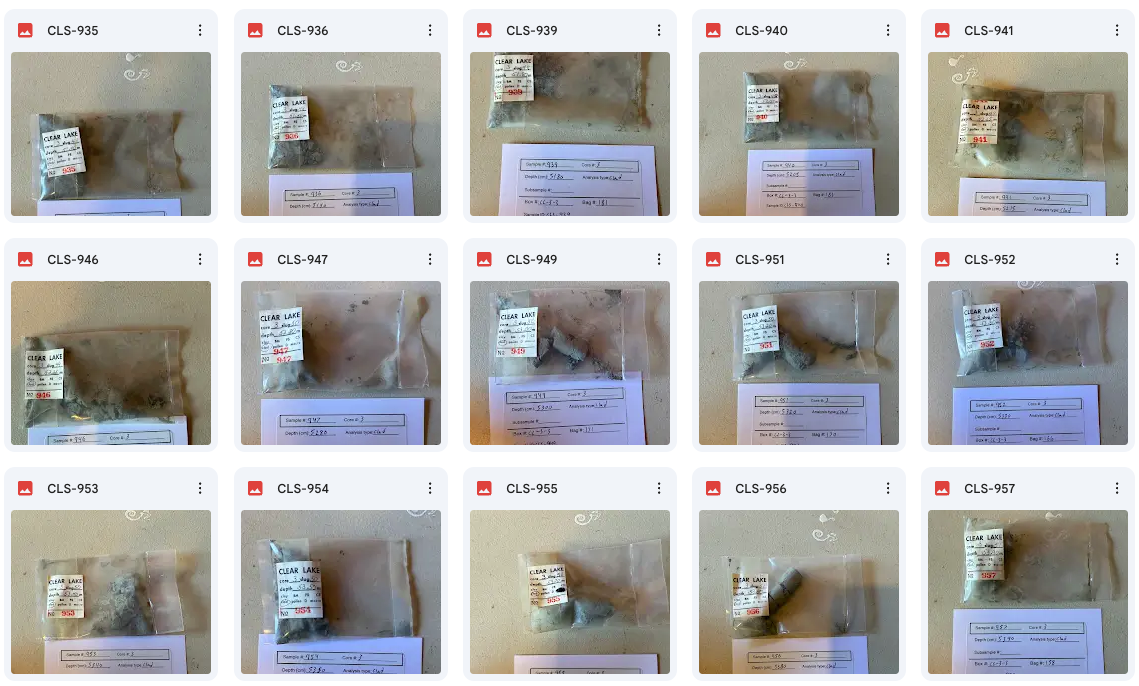
Cole is cleaning, organizing, cataloging and documenting 1000’s of Core Sample
Managing the Project and Building the Right Team
CLERC Operations Coordinator Rachel Avilla is currently managing the project and directly supervising Cole while coordinating communication among the people contributing scientific knowledge and historical context.
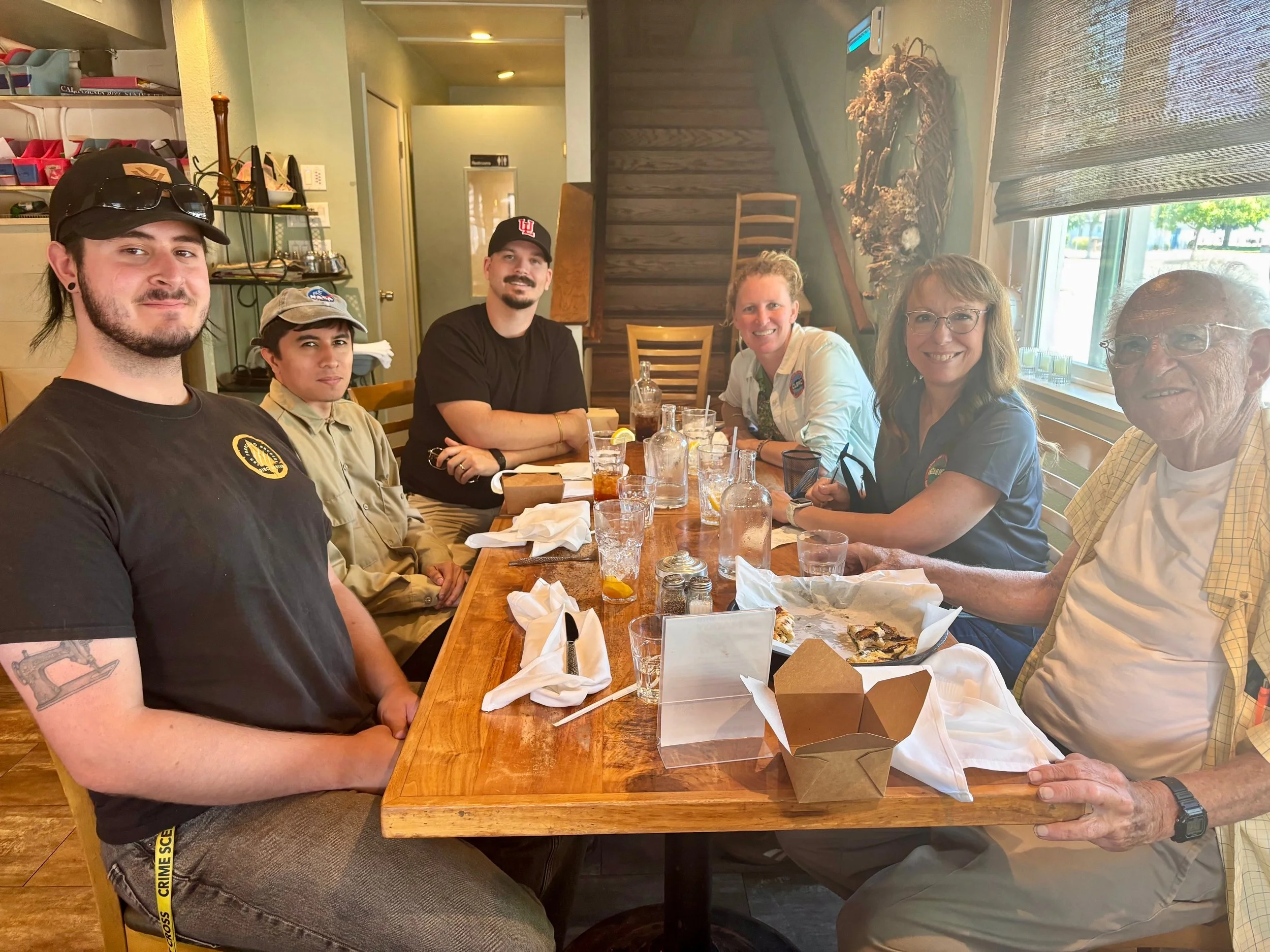
Left to right - Cole Hayes, Eduardo Alatorre-Acevedo, Connor McVey, Rachel Avilla, Operations Director Laura McAndrews-Sammel and David Adam.
That group includes David Adam; local geologist Connor McVey, a former student of David’s; geologist and CLERC board member Eduardo Alatorre-Acevedo; and Cole.
CLERC does not have the scientific staff or facilities to conduct all of the potential research ourselves. An important part of this initial effort is therefore figuring out what we have, what condition it is in, what questions it might help answer, and which outside researchers or institutions could provide the appropriate expertise.
We are also working to capture David’s firsthand knowledge of the collection. Labels and records can tell us a great deal, but after decades of work, some information may exist only in David’s memory. Recording that knowledge may help us reconnect cores with their original research context while also preserving an important chapter in the history of Clear Lake science.
What Could the Cores Tell Us?
In the previous parts of this series particularly Part 2, we explored the many ways sediment cores can help reconstruct Clear Lake’s environmental history—from changes in climate and ecosystems to wildfire, water quality, and volcanic activity. The collection now in CLERC’s care may still have more to tell us.
One area of particular interest is the volcanic ash, or tephra, preserved in some of the cores. These layers may provide additional information about past eruptions in the Clear Lake Volcanic Field, including their timing, frequency, and potentially changes in volcanic chemistry. That information could complement ongoing USGS research and monitoring of the volcanic field and contribute to a better understanding of regional volcanic hazards.
There may also be opportunities to evaluate whether some of these materials are suitable for additional dating techniques. We do not yet know what will be possible—and that is part of what makes preserving and documenting the collection so important. Until specialists have an opportunity to examine the cores and their associated records, we cannot know what new questions they may be able to answer.
A Small Project With Large Potential
CLERC has taken this project on with very limited resources.
We did not have dedicated funding available for an archival and scientific collection of this size. We made the decision to use a portion of our existing operating budget to hire Cole temporarily, secure storage, and begin the work because the alternative was risking the loss of materials that may have significant scientific and historical value.
We have made substantial progress. The original materials have been sorted and relocated, the cores are being cleaned and documented, and soon the collection will be together in one CLERC-managed location in Lakeport.
But this is only the beginning.
Future needs may include archival supplies, improved long-term storage, digitization, database development, scientific review, specialized analysis, dating of samples, and additional staff or research support.
CLERC will be looking for grants, donations, university collaborations, government partnerships, and other opportunities to continue the work.
Our goal is not to keep this collection locked away in storage. It is to protect it, understand it, and make it accessible so future researchers can ask questions that David and the original USGS scientists may never have imagined when the cores were collected more than 50 years ago.
The collection may also eventually become part of the story we tell at the future Discovery Center at the historic Carnegie Library—helping visitors see how layers of mud beneath Clear Lake can preserve evidence of ancient climates, changing ecosystems, volcanic eruptions, and thousands of years of life in this extraordinary place.
Sometimes scientific discovery begins with collecting something new.
Sometimes it begins by making sure something collected long ago is not lost.