
Restoring the Forest Together: North Shore Restoration Project Public Meeting
On Wednesday, July 8th, CLERC joined our partners for a public meeting at Robinson Rancheria in Nice to share how far the North Shore Restoration Project has come, and where it is headed next. The evening brought together the Mendocino National Forest's Upper Lake Ranger District, CAL FIRE, the Tribal Eco Restoration Alliance (TERA), Patriot Restoration Ops (PROPS), and CLERC, along with community members who came out to learn more and ask questions.
Our Stewardship Director, Tracy Cline-Meade, presented on behalf of CLERC, walking the room through the story of this work: where it started, what has been accomplished, and what the years ahead look like.
A Response to the Ranch Fire
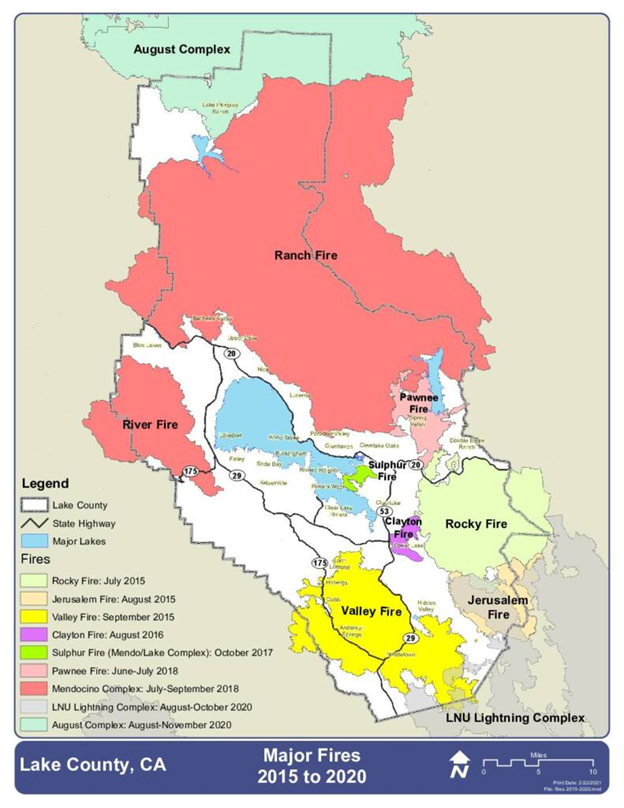
Fires in Lake County from 2015 - 2020
The North Shore Restoration Project is a 40,000-acre, post-fire recovery effort inside the footprint of the 2018 Ranch Fire. That fire, part of the larger Mendocino Complex, burned more than 459,000 acres and left lasting scars across the hillsides above the north and northeast shores of Clear Lake, near the communities of Nice, Lucerne, and Upper Lake.
Lake County knows this pattern all too well. Since 2015, nearly 70 percent of the county has burned in major wildfires, and close to 90 percent of the Mendocino National Forest has burned since 2018. After a severe wildfire, dense brush can quickly take over and remain for many years, slowing the return of a healthy forest. This project will help move the landscape through that brush-dominated phase more quickly by giving young trees the space and resources they need to grow. Over time, the goal is to restore a more natural forest structure, with a healthy mix of trees, shrubs, and open spaces that is better prepared for future wildfire.
Years of Groundwork
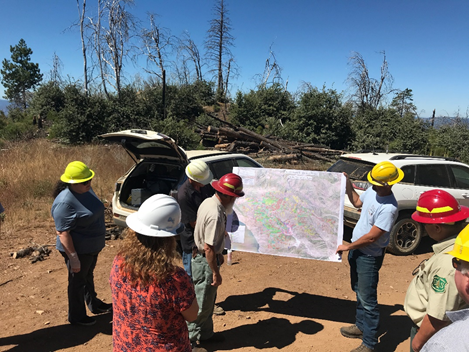
CLERC and the USFS in early planning stages out in the Mendocino National Forest.
The work now visible on the landscape rests on years of planning and funding. CLERC has pursued a series of CAL FIRE grants for the North Shore area, adding up to roughly $14 million invested in the Mendocino National Forest and neighboring lands.
That funding built on itself, one phase at a time. A 2019 Fire Prevention Grant cleared hazard trees along more than 500 acres of roadside, making the burned area safe enough for crews to even enter. A 2021 Forest Health Grant protected unburned "green islands" of surviving forest and funded a UC Davis research study on how a changing climate might shape recovery. Larger Forest Health Grants in 2023 and 2025 turned to the hardest-hit, high-severity burn areas, funding the biomass removal, site preparation, and replanting that reforestation requires.
Trees in the Ground
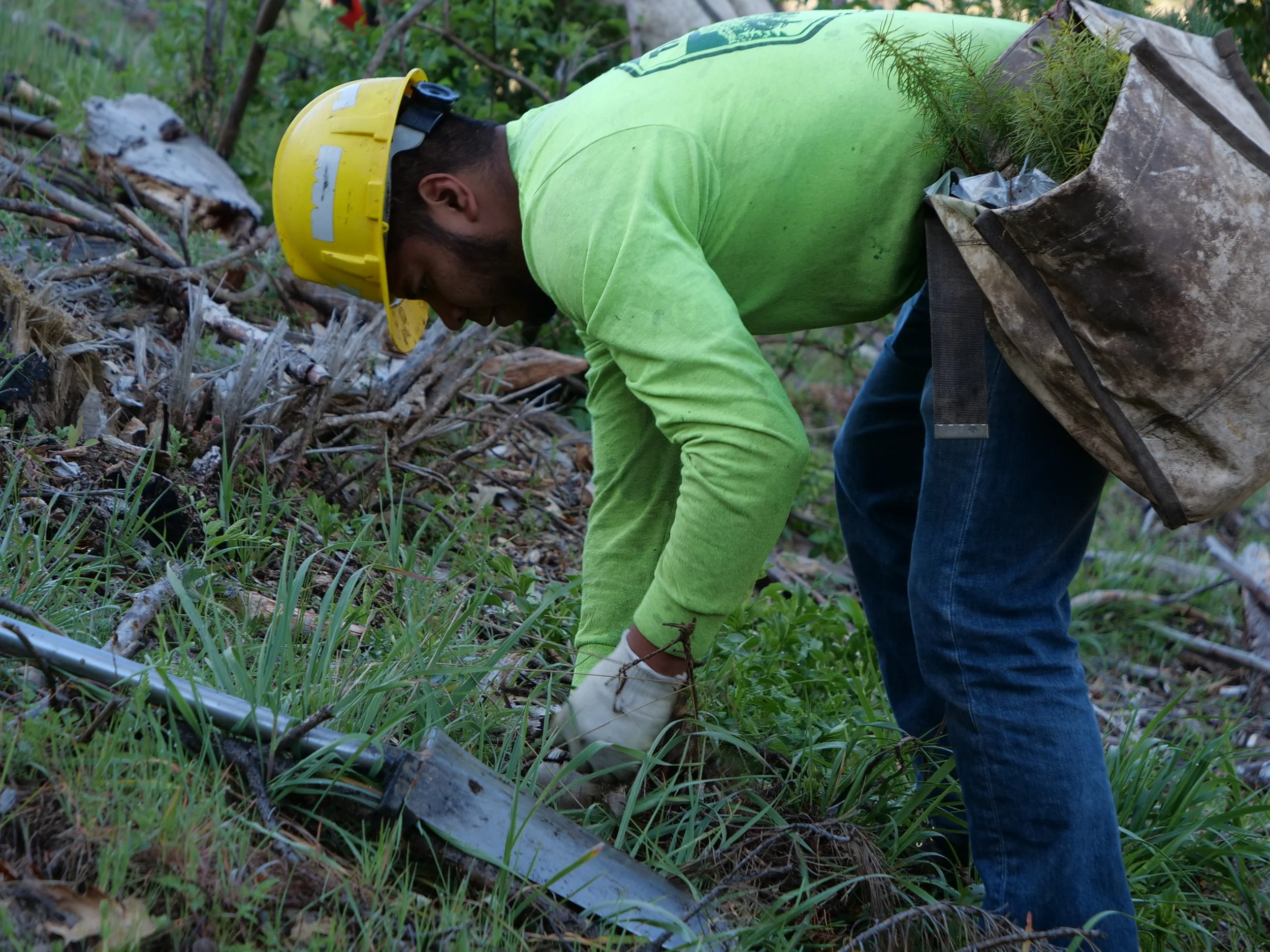
A crew member from PROPS plants a seedling in the Northshore Restoration Project area during the spring of 2026.
The most visible sign of progress is the trees themselves. Working alongside PROPS, CLERC planted 21,000 seedlings in the spring of 2025, then returned this spring to plant another 72,000. Those seedlings, mostly ponderosa pine, Douglas fir, and incense cedar, came from the U.S. Forest Service nursery in Placerville and were carried up into the hills by hand, one crew member and one seedling at a time.
PROPS deserves special mention here. The organization, which has helped with much of the site preparation and reforestation efforts, is dedicated to helping veterans transition from military service into careers in conservation and land management, which means every tree planted also helps a person build a new path forward.
Working With Nature, Not Against It
One of the ideas shared is that good restoration works with the forest rather than forcing it into neat rows. Many of the areas being treated were once plantations, with evenly spaced conifers all the same age, a pattern that can leave a forest more vulnerable when fire returns.
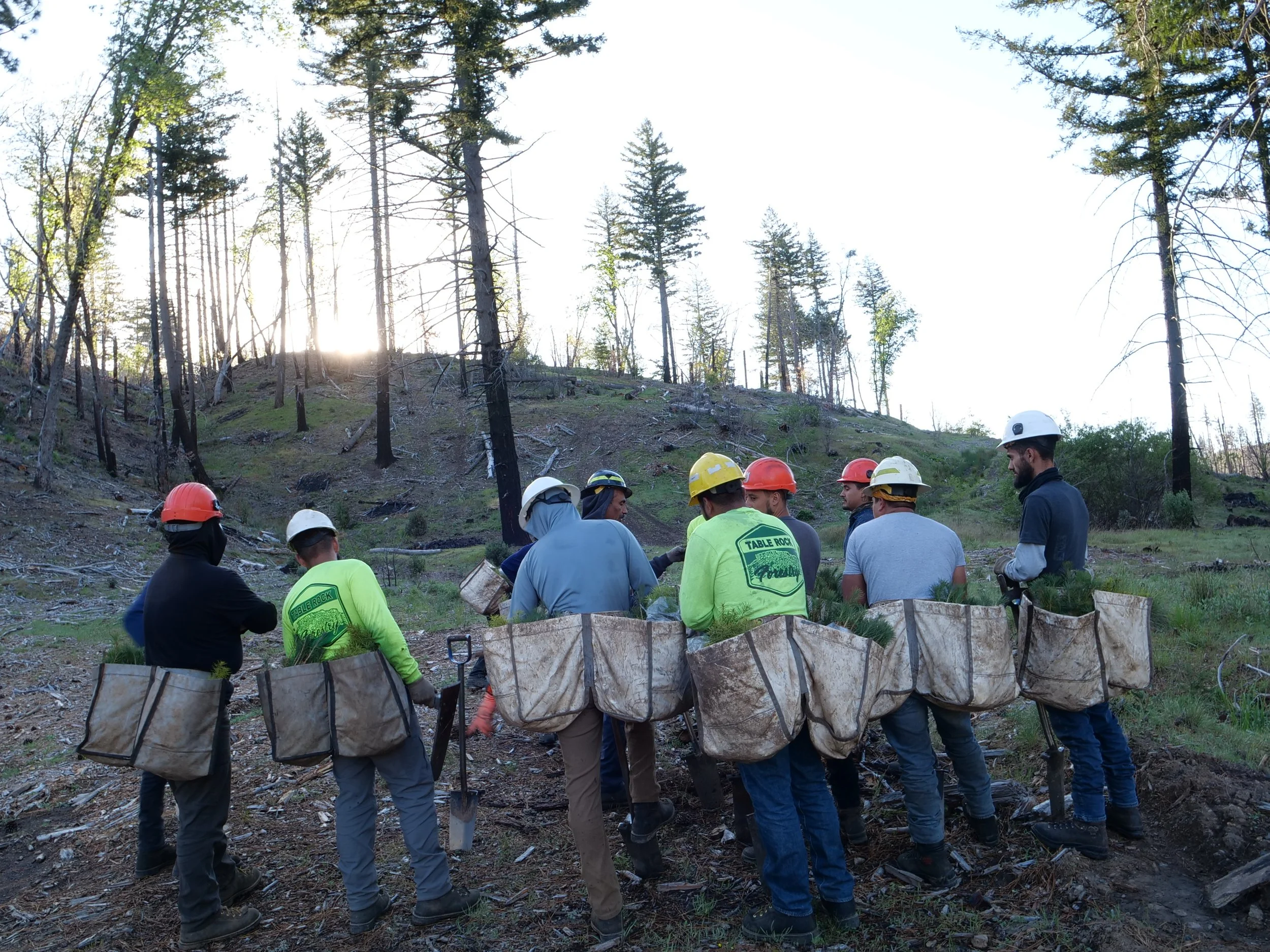
PROPS crew going over planting specifications and getting ready for a planting day.
Instead, crews were trained to plant in clusters, spacing new seedlings off the trees and shrubs already regenerating on their own. The result is a patchier, more natural mosaic that supports greater diversity across the landscape. Along the way, the team protects desirable native species that came back on their own after the fire, including black oak, madrone, manzanita, toyon, and redbud. A UC Davis modeling study helps guide where to replant what was there before, where to let nature take the lead, and where warming conditions call for species better suited to the future.
This approach fits naturally with the knowledge our partners at TERA bring to the table. As a Native-led collaborative rooted in Lake County, TERA weaves traditional ecological knowledge and cultural fire into the care of these ancestral lands, a reminder that people have been stewarding this landscape for a very long time.
The Long View
Restoration does not end when the last seedling goes in the ground. CLERC has marked trees and established monitoring plots across the treatment area to track how the young forest survives and grows, and we have deployed wildlife cameras to watch how animals return and use the land. That information will guide decisions about maintenance and future treatments for years to come.
This is a long-term commitment. The North Shore Restoration Project will continue for many years as more trees are planted, more acres are treated, and the forest is carefully tended back toward a healthier, more fire-resilient state.
We are grateful to everyone who came out on July 8th, and to our partners at the Mendocino National Forest, CAL FIRE, TERA, and PROPS. Restoring a forest of this size takes many hands, a solid plan, and a whole lot of persistence. Thank you for being part of it.
